
New Video: Protect Our Pipes
The Pick It Up – Toss No Más program is continuing to work with the Town of Silver City to identify improper waste disposal issues that threaten our Town’s infrastructure and over-burden Utilities Department staff.
One major issue we identified: the improper disposal of waste in our public sewer system. It’s a dirty problem, and one we’re excited to help fix in our mission to keep Silver City clean, healthy, and beautiful.
In June of 2025, we toured the Town’s sewer system to film a short video and learn more about challenges Utilities staff face every day. You can watch the video here and read more about what we learned on our tour below!
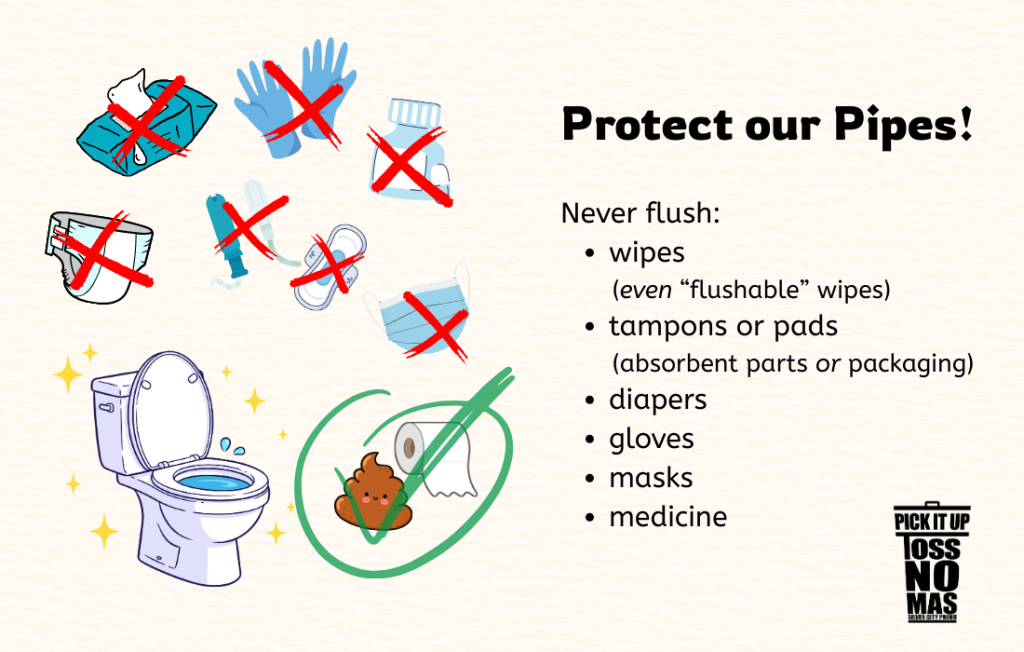
On the first stop of our tour, we visited one of the many sewer take-out points placed around town. Staff have to visit these points at least once per week to remove all the debris that gets caught in the traps. While they shared stories of exciting items (an entire jumpsuit?!) they’d found, they shared that the most common items were wipes, tampons, gloves, masks, diapers, and other sanitary items that people use in the bathroom. None of these items should ever be flushed our sanitary sewer system. In the last few years, there has been a huge rise in the volume of bathroom wipes that are being flushed, probably because companies are claiming that wipes are flushable. Our sewer system cannot handle wipes, even those marketed as “flushable,” because they don’t break down fast enough to prevent clogs in our sewer system and most of them are not biodegradable. Additionally, no parts of pads or tampons, the packaging, applicator, or absorbent material, should ever be flushed because, again, they are not biodegradable and can cause clogs. The constant maintenance that the Utilities Department must perform at these take-out points costs the Town staff time and taxpayer dollars and threatens our infrastructure. So please: only flush human waste and toilet paper down the toilet! Everything else should go in the trash.
Next, we visited a manhole downtown where grease often builds up. The maintenance workers removed shovel-loads of grease from the sewer pipe. The grease was cooled, so it was floating as a solid, grey, waxy layer over the top of the liquid below. It looked and smelled horrible. After they broke up the mass with shovels and scoops, a vacuum truck was brought in to suck the remainder of the goop out of the pipe. Grease gets into our sewer pipes when households or local restaurants pour cooking grease, wax, or other oily chemicals down their sinks. While it may be liquid when dumped, this grease quickly cools and lines the inside of sewer pipes, catching floating material, until a solid blockage is formed. When you’re disposing of oil and grease, please remember to let the oil cool, then soak it up with a rag or pour it into a container, and then throw that oily rag or container into the trash.

For our last tour stop, we visited Silver City’s (solar-powered) wastewater treatment plant to see how trash affects the final stages of cleaning and treating our water. A note: my description of these processes is abbreviated and focuses on how our wastewater treatment plant deals with solid waste and oils. We saw the huge piles of waste that get caught in the traps. There were lots of plastic wrappers, bathroom products, masks, and even a t-shirt. From there, liquids are further separated from solids and then floating oils and debris are skimmed off the top of the holding tanks. Interestingly, this stage of the process seemed relatively clean and there was almost no smell. Apparently the holding tanks only get stinky when lots of oils and grease build up. The water, once filtered of solids, is sanitized using UV light to kill any microbes. At the end of the process, the water is tested and treated to ensure that it meets surface water quality standards, then released back into San Vicente Creek, where it is used in agriculture, to irrigate the nearby golf course, and of course, utilized by the riparian plants and animals that live next to the stream. It felt like a very happy ending to our tour. But of course, this is only how the system works when everything is running smoothly and there are no major blockages.
Blockages, caused by trash being flushed down toilets or oils going into drains, can form anywhere in our Town’s sewer system. When blockages form, built-up sewer water will burst from the pipe anywhere it can find an exit: your bathtub, the pipe in your front yard, the main sewage line running through downtown, or even at one of the many points where the sewer lines cross underneath San Vicente Creek. Gross! Sewer overflows are a major health risk, especially for kids and pets that spend more of their time touching (and sometimes licking) the ground. Bacteria and human waste material can contaminate infrastructure, soils, and our waterways, creating far-reaching problems in our community. Through the Silver City Watershed Keepers program, we monitor the water quality within San Vicente Creek four times per year. This monitoring has caught multiple sanitary sewer overflows that have contaminated our urban watershed. Although we posted signs until the bacterial loads reached legal limits, there were probably impacts on humans, pets, and wildlife. We (YOU and ME, partner!) can help prevent these dangerous blockages.
Please, take a moment to audit your drain habits. And share this post with your friends and family.
Let’s work together to Protect Our Pipes, Silver City!

